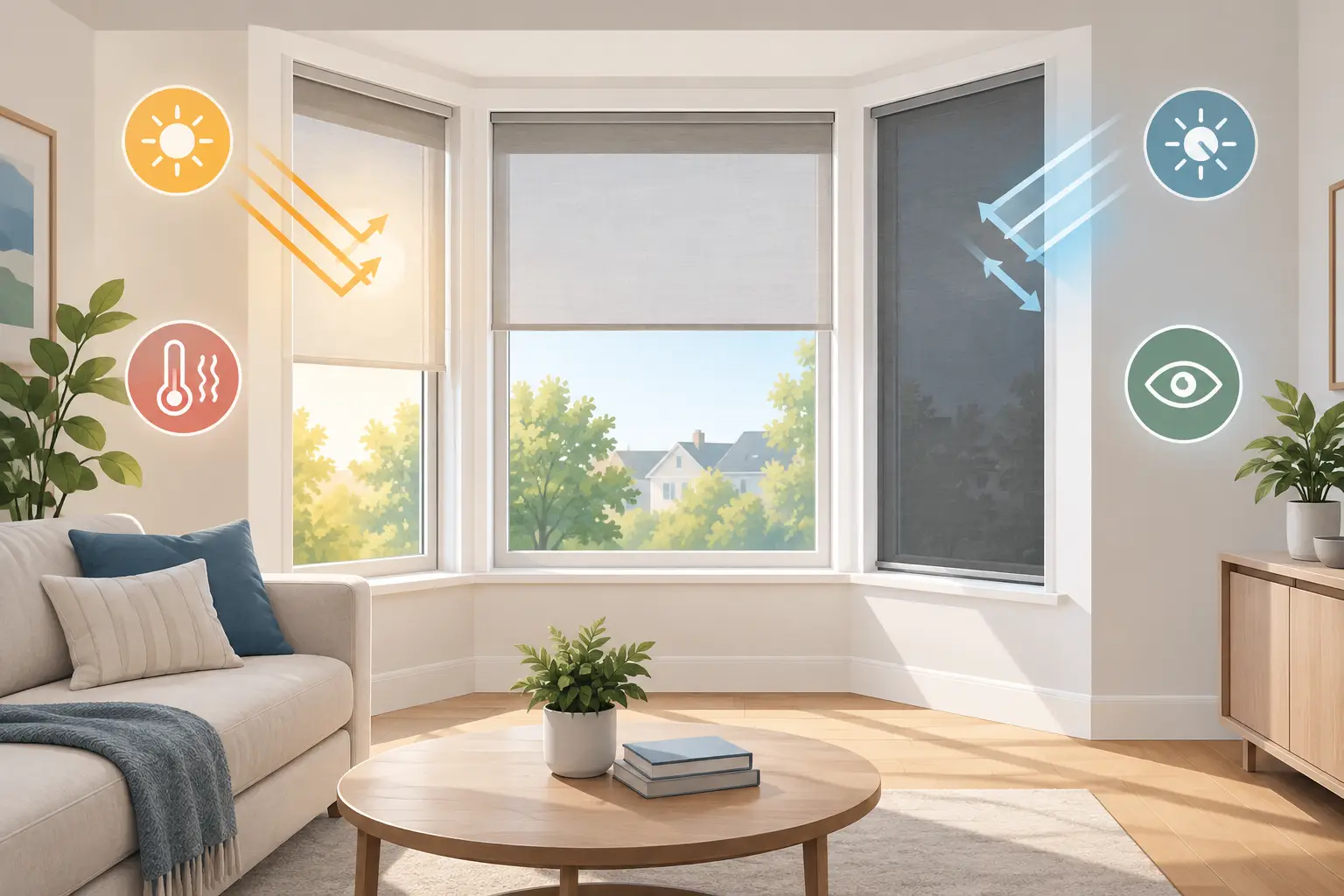
You know the moment. The sun shifts, and suddenly your monitor turns into a mirror. You tilt the screen, squint at spreadsheets, and crank brightness until your eyes feel cooked by mid-afternoon. If you are trying to reduce glare on computer screens windows are usually the real culprit – not the monitor.
Glare is rarely just “too much light”. It is the wrong light arriving at the wrong angle, bouncing off a glossy surface and wiping out contrast. The good news is that you can fix it without living in the dark. The right approach depends on whether you need a quick adjustment, a better long-term working setup, or a permanent building-level solution.
Why window glare is worse than you think
Glare from windows is a double hit: direct sunlight is intense, and even bright sky can create harsh reflections when it is in your field of view. Computer screens are designed for indoor lighting levels, so they struggle when the room brightness is many times higher than the screen can comfortably compete with.
It also changes through the day. A desk that is fine at 10am can be unusable at 2pm, especially in south- or west-facing rooms. In offices, one person might be fine while another gets the full reflection because their screen angle lines up with the glazing.
There is a comfort cost too. People often respond by closing blinds completely, which reduces daylight, encourages more artificial lighting, and can make a room feel flat and enclosed. If you are managing a workplace, that is a productivity and wellbeing issue, not just an annoyance.
Start with the simplest fix: move the screen, not your eyes
Before you buy anything, check your layout. The aim is to stop the window being “in” the screen.
If your monitor faces the window, you are asking for trouble. Rotate the desk so the window is to the side of the screen, not in front or behind it. If you cannot move the desk, even a small change in monitor angle can help – but it is rarely a complete fix when the sun is strong.
A useful rule: if you can see the bright window reflected on the screen when the monitor is off, you will probably get glare when it is on. Reduce that reflection first, then adjust screen brightness last.
Control the light you already have (without blocking it)
Most glare problems are solved by controlling how daylight enters the room. The catch is that some “solutions” create new issues: dark rooms, lost view, heat build-up, or privacy concerns.
Blinds and curtains: effective, but often all-or-nothing
Vertical blinds and roller blinds are common because they are quick. They also tend to be used like a switch: open or closed. That is fine for occasional glare, but not ideal for regular screen work.
If you rely on blinds, the best results usually come from maintaining a consistent position – enough to cut the bright patch, but not so much that the whole room becomes dim. Lighter fabrics can reduce glare while keeping the space usable, though they may not deal with low-angle sun.
Trade-off: blinds can be fiddly in shared spaces. One person closes them, another opens them, and the glare problem returns.
Net curtains and sheer fabrics: gentle, limited
Sheers are good for diffusing bright sky. They are less effective against direct sun, especially in rooms where the sun hits the glass for long periods.
They can also add privacy in daytime, but again, it depends on light levels. When it is bright outside and darker inside, they help. In the evening with lights on, they do very little.
Anti-glare monitor filters: a patch, not a cure
Screen filters can cut reflections and soften glare. They can also slightly reduce sharpness and colour accuracy, which matters for design work, photo editing, or detailed CAD.
They work best when glare is moderate. If you have strong sunlight coming through the window, a filter might simply turn “mirror glare” into “washed-out glare”.
Adjust lighting so the screen is not fighting the room
If you are increasing monitor brightness to cope, you are treating the symptom. Aim for balanced ambient light instead.
Switching harsh overhead lighting for softer, more even light can help, but the window is still the biggest variable. In commercial spaces, consider whether ceiling lights are reflecting on screens as well as windows. Sometimes you have two glare sources and only notice the obvious one.
The most reliable fix: treat the glass
When glare is frequent, the most effective long-term option is to control solar energy at the window. This is where professional-grade window film comes into its own.
Window film works by reducing the intensity of light and heat that passes through the glazing and by cutting reflective glare at source. The room stays bright, but the harsh edge is taken off the daylight – so screens remain readable and people are not constantly adjusting blinds.
Which film type helps reduce glare on computer screens from windows?
Not all films are the same, and the “best” choice depends on what you need to protect: comfort, visibility, privacy, or appearance.
A neutral solar control film is often used where you want glare reduction with minimal change to how the glass looks. This suits many home offices and reception areas where you still want a clear view out.
A reflective film tends to give stronger daytime glare reduction and can add daytime privacy. It is a popular choice for offices, shopfronts, conservatories, and static caravans where occupants want to see out but feel less overlooked. The trade-off is appearance: reflective finishes are more noticeable from the outside.
A dual-reflective or internal-reflective style can be useful where you want privacy and glare reduction while keeping the exterior look more subtle, but performance depends on the lighting balance (bright side versus dark side). Like most privacy solutions, it is strongest in daytime.
If your main issue is direct, low-angle sun at certain times, film can reduce the peak glare dramatically. If the problem is bright sky rather than direct sun, a lighter film may be enough.
Homes: keep the room bright, make screens usable
Home working spaces are often set up where there is room, not where the light is ideal. South-facing lounges, kitchen-diners, and converted conservatories commonly cause screen glare.
Film is a practical way to keep natural light without turning the space into a cave. It also provides UV protection, which helps protect flooring, furniture, and soft furnishings from fading – useful if your desk is near a window and the sun hits the same area daily.
Offices and commercial spaces: fewer complaints, more consistency
In offices, glare is a recurring disruption. One workstation gets hit, then the blinds go down for everyone. If you are managing a workplace, film creates a consistent baseline so the space works throughout the day.
It can also reduce heat gain, which can ease pressure on cooling in summer. That matters for staff comfort and can support energy efficiency, particularly in glazed frontages and modern buildings with large window areas.
Static caravans: comfort, privacy, and glare control in one move
Static caravans often have large windows for the view, but that can make internal comfort difficult in bright coastal locations. Screen glare can be an issue if you are working remotely or even just trying to watch television during the day.
A reflective or solar control film can reduce glare and help keep interiors cooler, while also improving daytime privacy. The balance is choosing a finish that suits how you use the caravan – some owners prioritise privacy, others want the clearest possible outlook.
What to expect from a professional installation
For glare control to be reliable, the film needs to be matched to the glazing and fitted correctly. Different glass types can react differently to solar control products, and performance varies by orientation and shading.
A proper specification looks at where the glare is coming from (direct sun or bright sky), what time of day it is worst, and whether you also need heat reduction, UV protection, or privacy.
Once fitted, the change is usually immediate: screens become readable without pushing brightness to the limit, and occupants stop playing “blind roulette” every time the weather changes.
If you are in North Wales, The Wirral, or Chester and want a commercial-grade solution, Tinting For Glass (Solar Tint Wales) provides supply-and-installation window film services for homes, static caravans, conservatories, and commercial premises, with options focused on anti-glare performance, UV protection, and privacy.
A few “it depends” scenarios that matter
Glare control is not one-size-fits-all, and it is worth being honest about the trade-offs.
If you need perfect colour accuracy (design studios, print work), a very dark or strongly reflective film may change how you perceive colour indoors. In those spaces, a more neutral film with measured glare reduction is often a better compromise.
If you want privacy at night, most daytime privacy solutions are limited. When it is brighter inside than out, reflections reduce and people can see in more easily. In that case you may still want blinds or curtains for evenings, even if film handles daytime glare.
If your screen glare only happens for 30 minutes at a certain time of day, a layout tweak or a blind position habit might be enough. If it happens most afternoons for half the year, treating the glass will be less effort in the long run.
Glare is a productivity issue, a comfort issue, and often a heat issue all at once. The most helpful mindset is to stop fighting it with screen brightness and start controlling the daylight properly – so your room stays bright, your view stays open, and your screen stays readable when it matters.